To understand the Dino 308 GT4, it helps to step back into the early 1970s.
This was not a calm period for the automotive world by any means. Political tension, economic uncertainty, and tightening safety and emissions regulations were reshaping what a sports car could be — and what it was allowed to become.
Ferrari, long defined by its racing mythology and twelve-cylinder tradition, was not immune to these pressures either.
Hence the 308 GT4 emerged not as a stylistic experiment, but as a pragmatic response to a rapidly evolving world — a Ferrari built at the edge of transition.
Ferrari in the Early 1970s
By the beginning of the decade, Ferrari was undergoing a quiet transformation — shaped as much by necessity as by ambition.
Only a few years earlier, the company had come dangerously close to financial collapse. In 1969, Fiat had acquired a 50 percent stake in Ferrari, bringing much-needed stability, but also a new industrial reality: shared resources, new oversight, and a gradual restructuring of how the Ferrari company operated.
Production numbers were rising, customer expectations were shifting, and the company was preparing for a future less reliant on its traditional V12 grand tourers.
At the same time, the outside world was closing in. New emissions standards, stricter noise regulations, and evolving safety requirements forced manufacturers to rethink engineering solutions that had remained largely unchanged for decades.
The early 1970s had become a moment of recalibration: not particular a break with the past, but the beginning of something unfamiliar.
Ferrari needed new ideas — not to replace its heritage, but to ensure its survival.
The GT4 would become one of the clearest expressions of that shift.
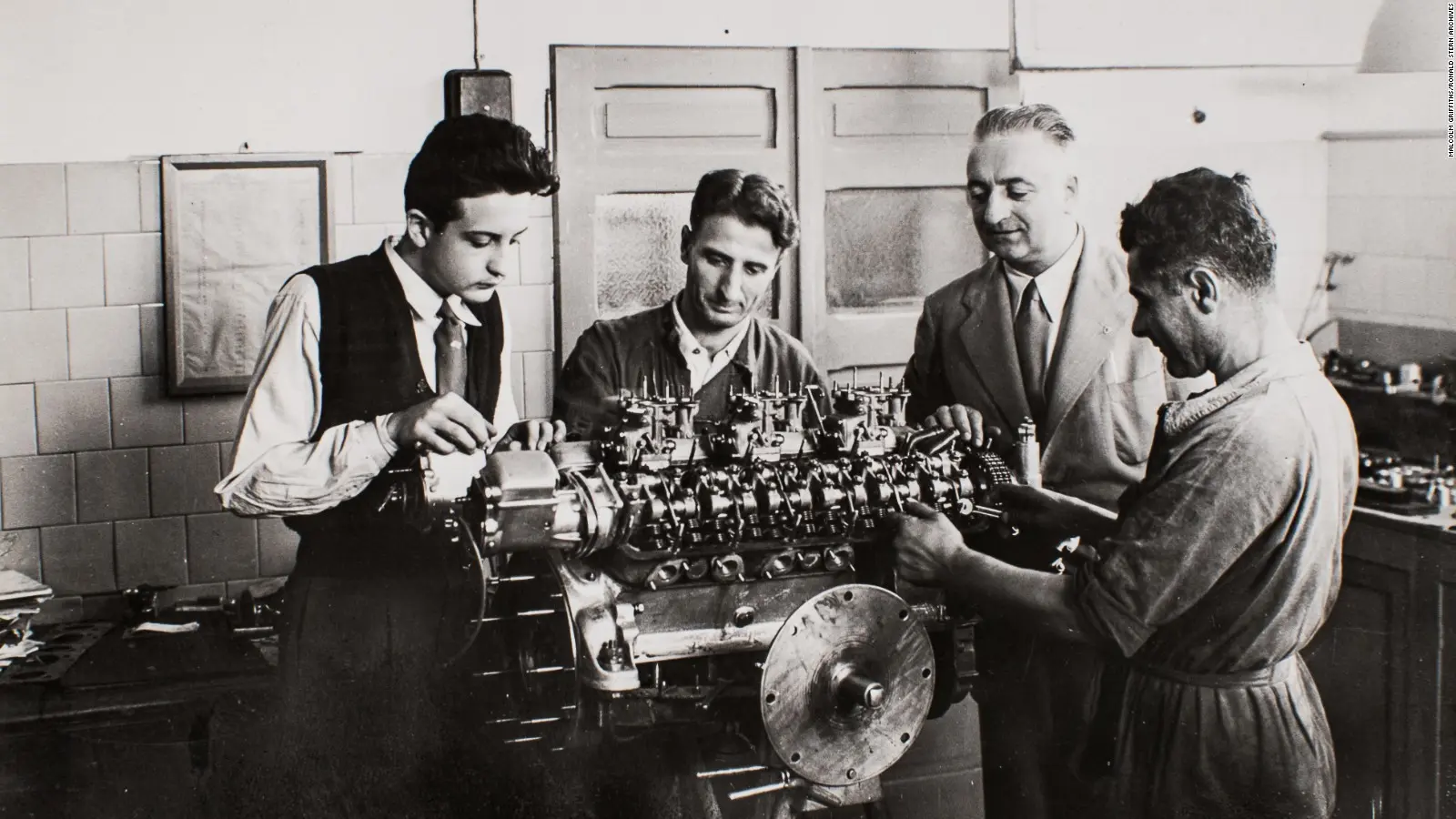
Alfredo “Dino” Ferrari (left) alongside his father Enzo at the heart of the factory - long before the son's name would define an entire line of cars.
The Role of the Dino Brand
The Dino name had been introduced earlier as a way to honor Alfredo “Dino” Ferrari and to differentiate smaller-engined cars
from Ferrari’s twelve-cylinder flagships.
By using the Dino badge for the 308, Ferrari was able to draw a line between tradition and what came next.
Under this strategy, V6 and later V8 models could explore new layouts, production methods, and market segments without directly challenging the brand’s established image.
For many enthusiasts, the name Dino was inseparable from the earlier 206 and 246 models — compact, elegant cars closely associated with Ferrari’s racing spirit.
They defined the emotional image of the Dino brand long before the 308 GT4 appeared.
The GT4, being larger, more angular and more practical, stood in contrast to this image — and therefore faced a hard time, getting compared with cars it was never meant to replace.
Understanding this contrast is essential, as much of the GT4’s early criticism was rooted not in its own shortcomings, but in the expectations inherited from its predecessors.
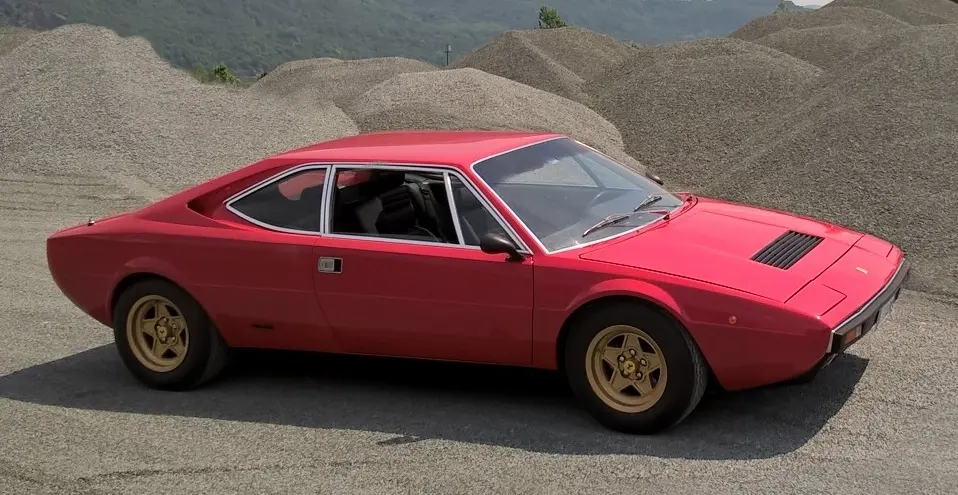
A later 308 GT4 — now wearing Ferrari badging, with the larger Campagnolo “star” wheels that gave the shape an even sharper, more mature presence.
Ferrari kept the 308 GT4 under the Dino name until the mid-1970s, drawing a careful boundary between heritage and experiment.
On paper, the strategy made sense: Dino would house the V6 and V8 cars, protecting Ferrari’s V12 mythology from dilution.
But the market did not follow that theory.
In places like the United States — where buyers expected the Prancing Horse as much as the engineering — the absence of Ferrari badging created hesitation and weak sales numbers.
Dealers struggled to explain a Ferrari that was not quite allowed to say its own name.
So by 1976, the badges began to change. The Cavallino appeared —
not because the car had improved, but because the world around it demanded clarity.
Gradually, the prancing horse returned — on the nose, the rear deck, even the wheel centers — small symbols that finally told observers what the shape alone could not.
Early GT4s could pass almost anonymously: no crest, no script, no immediate recognition.
Only when the engine cover was lifted did the name appear quietly on the cam covers, as if Ferrari itself was still deciding how loudly to speak.
As it turns out, the Dino badge was not merely branding — it was a deliberate boundary between Ferrari’s heritage and its next experiment.
For the 308 GT4, this positioning was therefore both an opportunity and a limitation.
It allowed Ferrari to introduce its first production V8 road car, but it also distanced the model from the emotional prestige associated with the Ferrari name itself.
In retrospect, the Dino badge reveals more about Ferrari’s internal caution than about the car’s actual significance.
A Changing Market
As mentioned, the early 1970s marked a subtle shift in what sports cars were expected to be.
Performance still mattered — not unusual for that type of category. But buyers were beginning to ask for something more than just speed alone. Practicality, comfort, visibility, even interior space were no longer secondary concerns, even in cars built for emotion.
At first the idea of a mid-engined Ferrari with usable rear seats seemed ambitious — and, to many, almost contradictory.
Yet this was the direction the industry itself was exploring.
Across Europe, manufacturers had already started experimenting with wedge-shaped forms, compact proportions,
and layouts that tried to reconcile performance with everyday usability.
Cars like the Lamborghini Urraco, the Maserati Merak, or the Lotus Esprit reflected a broader movement: sports cars becoming sharper, more design‑driven, and increasingly practical for everyday use.
Ferrari’s step into this territory, although necessary, felt cautious, almost restrained.
Rather than presenting the GT4 as a new flagship, the company had positioned it carefully under the Dino name — and entrusted its design not to Pininfarina, but to Bertone.
What set Ferrari apart was not the ambition of the concept, but the measured way it was introduced: a car that carried innovation quietly, almost defensively, even as it pointed toward the company’s future.
In hindsight, the GT4 was not an outlier — It was Ferrari's way of testing the shape for what would come next.
But, as we have learned, innovation rarely arrives to applause.
And in the case of the 308 GT4, the world was not immediately ready to understand what Ferrari had built.
As mentioned, the early 1970s marked a subtle shift in what sports cars were expected to be.
Performance still mattered — not unusual for that type of category. But buyers were beginning to ask for something more than just speed alone. Practicality, comfort, visibility, even interior space were no longer secondary concerns, even in cars built for emotion.
At first the idea of a mid-engined Ferrari with usable rear seats seemed ambitious — and, to many, almost contradictory.
Yet this was the direction the industry itself was exploring.
Across Europe, manufacturers had already started experimenting with wedge-shaped forms, compact proportions,
and layouts that tried to reconcile performance with everyday usability.
Cars like the Lamborghini Urraco, the Maserati Merak, or the Lotus Esprit reflected a broader movement: sports cars becoming sharper, more design‑driven, and increasingly practical for everyday use.
Ferrari’s step into this territory, although necessary, felt cautious, almost restrained.
Rather than presenting the GT4 as a new flagship, the company had positioned it carefully under the Dino name — and entrusted its design not to Pininfarina, but to Bertone.
What set Ferrari apart was not the ambition of the concept, but the measured way it was introduced: a car that carried innovation quietly, almost defensively, even as it pointed toward the company’s future.
In hindsight, the GT4 was not an outlier — It was Ferrari's way of testing the shape for what would come next.
But, as we have learned, innovation rarely arrives to applause.
And in the case of the 308 GT4, the world was not immediately ready to understand what Ferrari had built.
When the Dino 308 GT4 was introduced, the automotive world was undergoing a profound shift.
The 1973 oil crisis didn’t just change fuel prices — it reshaped expectations and priorities of an entire industry.
Without the Oil crisis, Ferrari might have continued refining the V6 for longer instead of exploring the alternative.
While the company had been relying on the exquisite but costly Dino 206, its rivals were already adapting to the new reality:
The Porsche’s 911 had become the benchmark for reliability, usability, and efficiency.
Lamborghini’s Urraco had introduced a compact, modern V8 while Maserati’s Merak offered a lighter, more accessible mid engined package.
Ferrari could no longer afford to be the emotional outlier — it needed a car that could compete on practicality as well as passion.
Suddenly, impractical cars with thirsty engines were politically unpopular and economically risky. While the 246 Dino’s V6 wasn’t excessively thirsty, it was expensive to manufacture, complex to service and not easily scalable for a broader model range.
Ferrari needed a powerplant that was more efficient, more affordable, and more adaptable without sacrificing performance.
The Quiet Revolution
When looking back, the 308 GT4 feels less like an outlier and more like a bridge.
It connects Ferrari’s past to its future — tradition to experimentation, myth to reality.
Its story is not one of immediate acclaim, but of long-term relevance.
To understand the GT4 is to understand how progress often arrives quietly — and is only appreciated much later.
Free AI Website Maker