Few aspects of the Dino 308 GT4 have shaped its reputation as decisively as its design.
Sharp, angular, and unmistakably different from what people expected of a Ferrari at the time, its shape became a lasting point of contention.
But to better understand the GT4’s design, it helps to look beyond taste and fashion — and instead consider intent, constraint, and context.
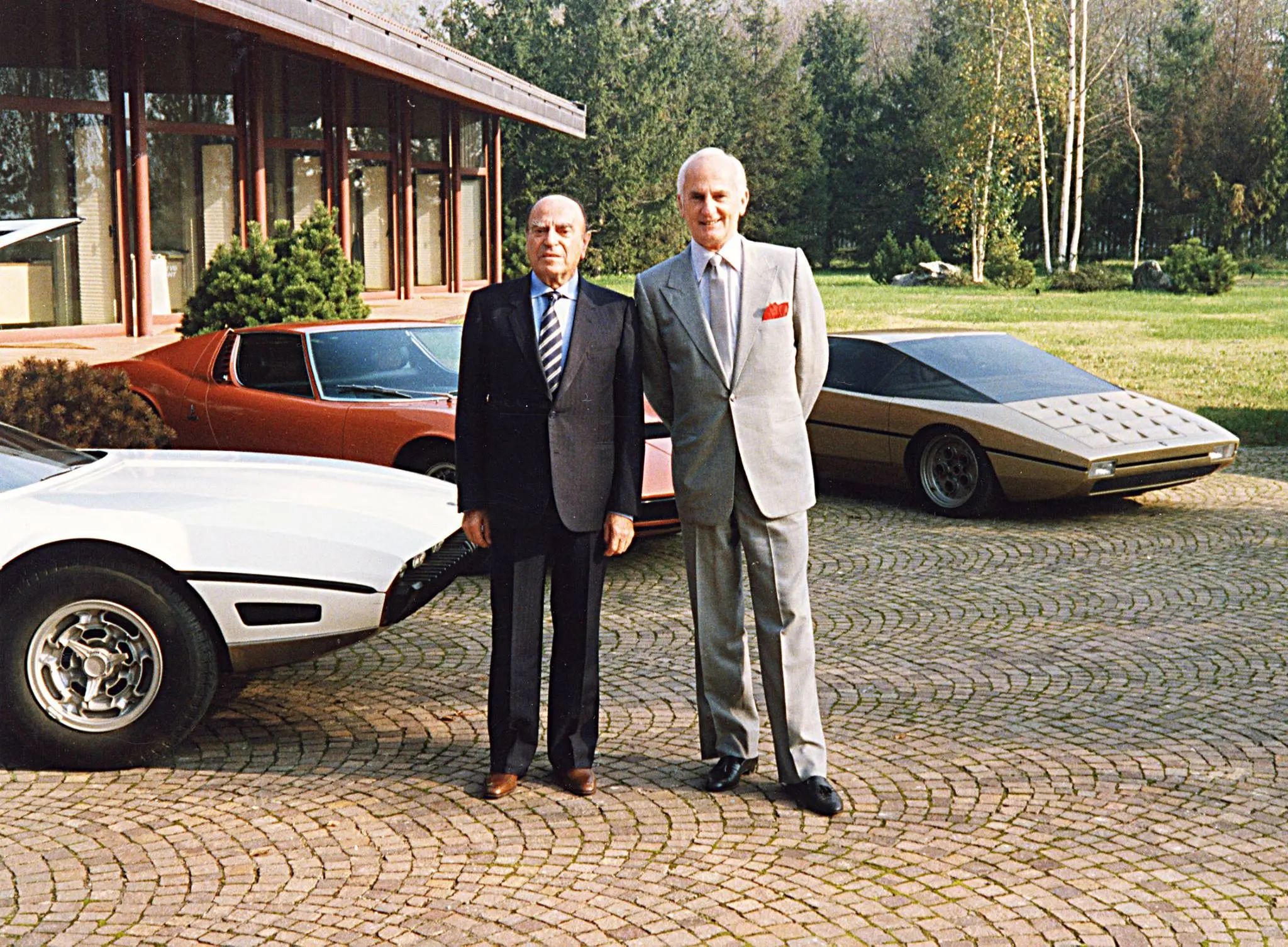
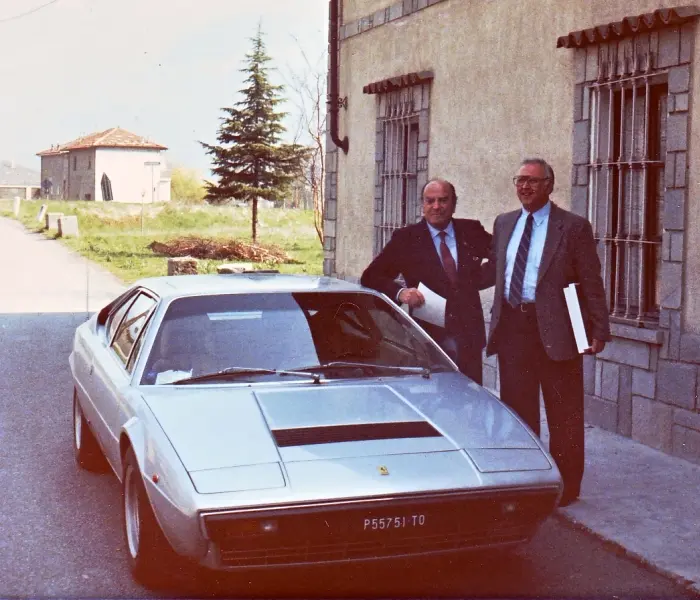
Nuccio Bertone (left) with the 308 GT4 .
Why Bertone?
By the early 1970s, Pininfarina had become almost inseparable from Ferrari’s visual identity — effectively the company’s house coachbuilder, and responsible for the appearance of its road cars.
Flowing lines and elegant proportions defined what many believed a Ferrari should look like. An agreed sense of beauty.
The 308 GT4, however, arrived with requirements that challenged those traditions: a mid-engine layout, four usable seats, acceptable visibility, and compact exterior dimensions.
Rather than forcing these demands into familiar shapes, Ferrari turned to Bertone — a studio known for experimentation, clarity, and the ability to translate functional constraints into coherent form.
In that context, choosing Bertone over Pininfarina was more than a stylistic footnote. It was a quiet break from convention.
The decision was pragmatic, not provocative.
For once, Ferrari’s future was being shaped not in Pininfarina’s studios, but under Bertone’s roof.
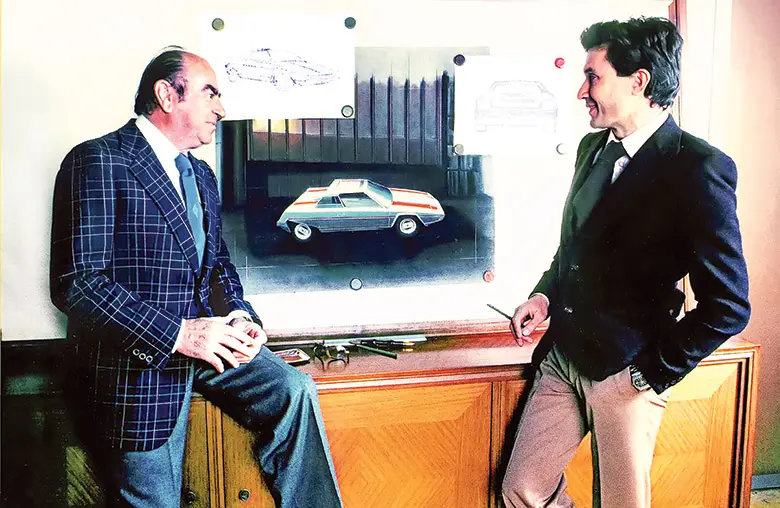
Nuccio Bertone and Marcello Gandini (right) with the Ferrari Rainbow drawings.
Marcello Gandini’s Hand
The Dino 308 GT4 is closely associated with the great Marcello Gandini, one of the most influential automotive designers of his era.
His work in this period explored geometry, proportion, and precision — clarity over ornament.
A related design language had already appeared in the Lamborghini Urraco, first shown in Turin in 1970 and entering production soon after. Some even argued, Gandini had simply presented a design proposal which had been declined by Lamborghini earlier.
And the similarities are evident: the straight beltline, the wedge-like stance, the disciplined surfaces.
Yet, the GT4 represents a more restrained interpretation of these ideas.
Ferrari chose to soften some of the Urraco’s more theatrical gestures, opting instead for a cleaner, more integrated rear design.
Even the interior reflects a different philosophy — lighter, more refined, and noticeably more delicate in execution.
Both cars share a lineage, but the GT4 translates Gandini’s concepts into something closer to Ferrari’s own expectations of quality and subtlety.
Every line serves a purpose — visually or functionally — resulting in a form that prioritizes structure over drama.
Design Driven by Engineering
The wedge-like profile of the 308 GT4 wasn’t a styling exercise for its own sake.
It wasn’t drawn simply to shock Ferrari traditionalists or to follow a trend.
It came from necessity.
The GT4 had to package a transversely mounted V8 behind the cabin, while also making room for rear seats and a usable interior — a rare combination for Ferrari at the time. Those demands shaped everything: the roofline, the proportions, the car’s very stance.
There was no space for decorative curves or romantic grand touring drama. The design had to be clean, efficient, and honest — built around the car’s layout rather than around old expectations of what a Ferrari should look like.
That’s why, to this day, the GT4 feels so architectural. Its lines are sharp, its surfaces controlled, and its geometry deliberate. Instead of hiding its structure, it puts it on display.
The car looks exactly like what it is: a mid-engined 2+2, designed with function in mind.
The large window screen wasn’t just a visual signature either — it made the cabin brighter, improved visibility, and gave the car a sense of practicality that other sports cars rarely considered. Even the upright stance and straight beltline serve a purpose: usability as much as presence.
The proportions reflect internal constraints more than external ideals.
Where earlier Ferraris were shaped by elegance and emotion, the GT4 feels shaped by logic.
Seen from this perspective, the car reads less as rebellion and more as honesty: form shaped by function, design driven by engineering — without disguise.
In that sense, its sharpness was not excess, but discipline.
Colors & Character
And yet the 308 GT4 was never meant to feel cold or clinical — it was Italian after all.
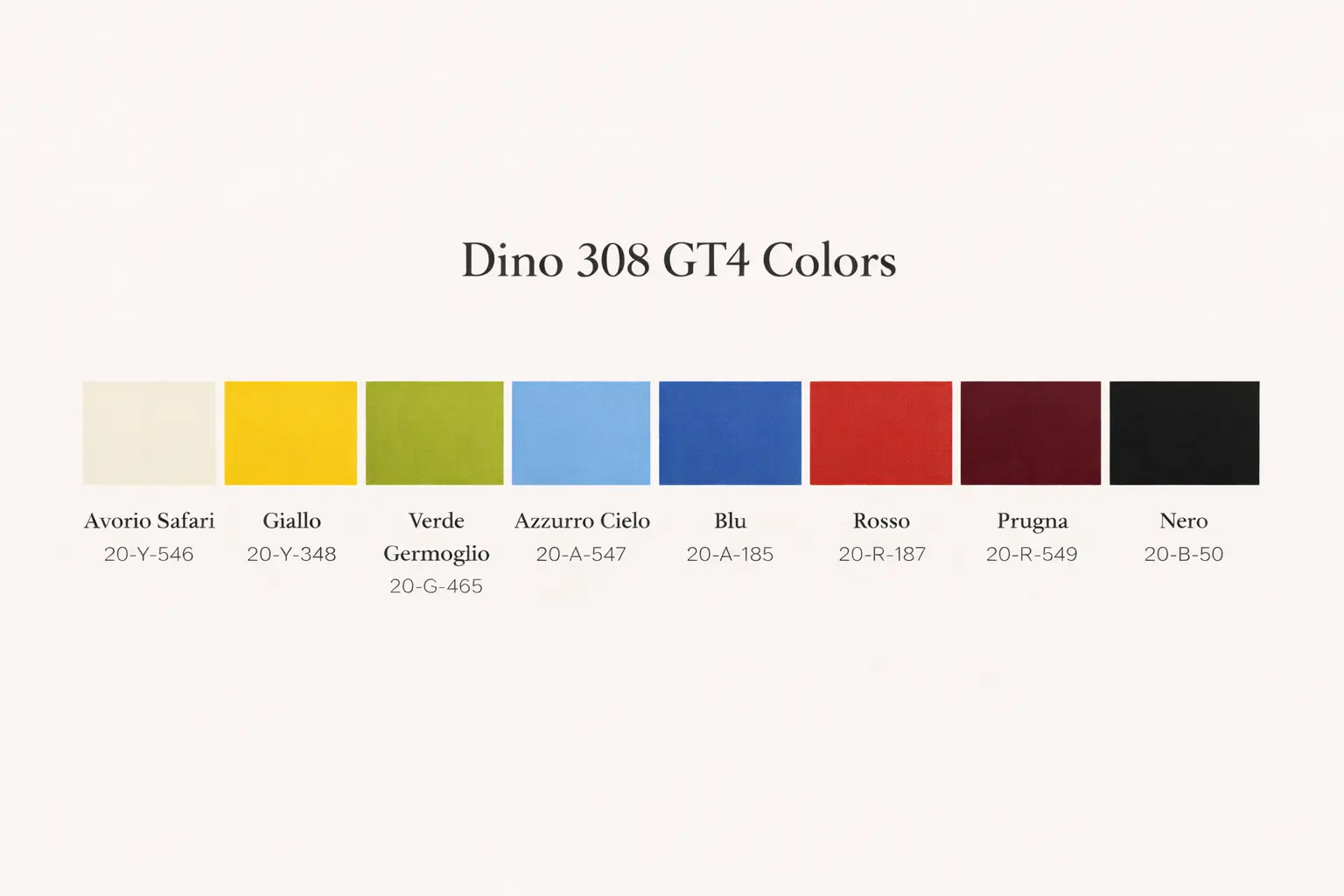
The artisans of Maranello’s paint shop offered it in a surprisingly rich palette of early-1970s tones — deep metallic browns, understated silvers, vivid reds, lively greens, and quiet blues that softened the geometry and transformed the car’s presence.
In some shades, the wedge form looked severe and rather sharp.
In others, it became elegant — almost restrained.
The design remained the same, but the emotional tone shifted dramatically.
Even here, perception was not only about shape.
It was also about more personal aspects: atmosphere and emotions.
Colors like Avorio Safari, Azzurro Cielo, or deep Prugna gave the car a distinctly European character — less supercar, more sophisticated grand tourer.
Reception and Reassessment
At launch, the GT4’s appearance divided opinion.
Compared to the softer, more sensual forms of the earlier 206 and 246 Dinos, the car appeared stiff, geometric, and unfamiliar — almost too rational for a brand built on emotion.
To some, it felt like a break in the carefully crafted Maranello tradition.
Yet over time, perceptions have evolved.
What once seemed awkward now appears reserved and purposeful. The clarity of the design aligns naturally with the engineering behind it.
In an era increasingly shaped by nostalgia, the Dino 308 GT4 stands apart — not by trying to recall the past, but by remaining faithful to the ideas of its time.
Timeless
The design of the Dino 308 GT4 does not seek universal approval.
It rewards attention rather than instant admiration.
Understanding it means accepting that elegance can take many forms — and that some designs reveal their value only once fashion has moved on.
The GT4’s shape is not timeless because it is neutral.
It is timeless because it is specific: a product of the moment, executed with confidence.
In retrospect, the Dino 308 GT4 feels less like an outlier and more like an actual statement of intent.
A reminder that even Enzo’s most established brand identity was, at times, willing to step outside its own mythology.
Bertone’s work on the GT4 was not about chasing consensus — it was about pushing form forward, with discipline and clarity.
And that is part of the car's legacy: not as a mere exception to Ferrari’s history, but as proof that design progress often begins where comfort ends.
No Code Website Builder