What is a Dino 308?

Engineering & Layout

The engineering of the Dino 308 GT4 cannot be separated from its layout.

Many of the car’s most discussed characteristics — its proportions, its interior space, even its visual presence — were not born from styling ambition, but from technical necessity.

To understand the GT4 is to understand Ferrari’s challenge in the early 1970s:
how to place a mid-engine V8 behind the seats, preserve balance, and still create something genuinely usable.

In doing so, Ferrari was not simply building a new model.
It was quietly laying the foundation for an entire future generation of road cars.


The 2+2 Concept

Perhaps the most controversial aspect of the GT4’s engineering was its 2+2 seating arrangement.

Since most of the competition had already introduced their own four‑seat sportscars (Lamborghini Urraco, Maserati Merak, Porsche 911), the engineers at Maranello had no choice but to develop their own version to keep up.

From a technical standpoint, this decision drove nearly every major layout choice. Rear seats required a longer cabin, improved visibility, and careful packaging of mechanical components.

While the rear seats were never intended for long journeys by adults, they significantly expanded the car’s practical envelope — especially when combined with the surprisingly large trunk, which gave the GT4 far more usable storage than most Ferraris of its era.

In engineering terms, the GT4 represents a compromise — but a deliberate and intelligently executed one.

It was not an attempt to soften the sports car, but to expand what one could be. 

Mobirise Website Builder

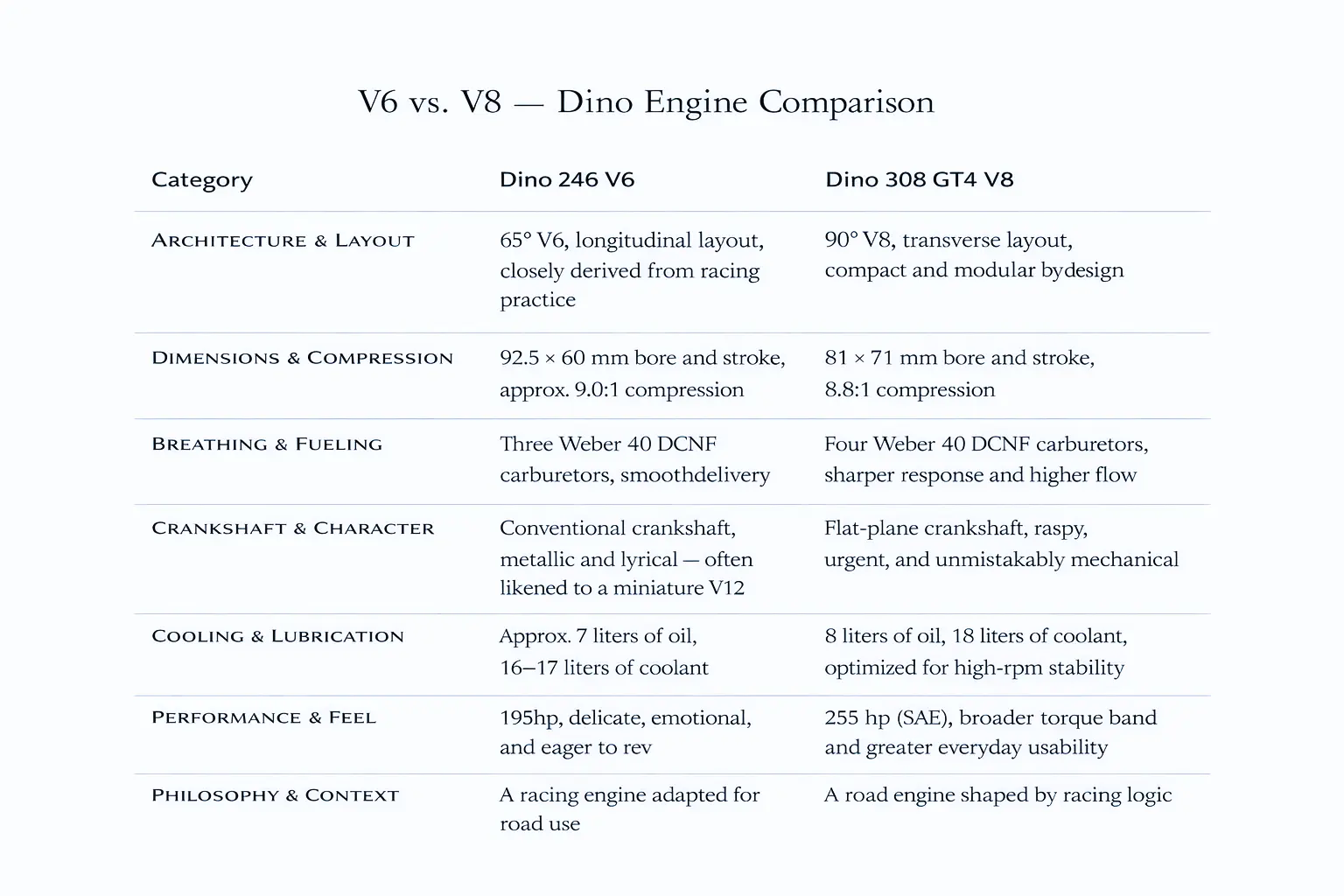
The new V8 produced 255 SAE hp through four twin carburetors, later listed as 230 DIN hp.

The V8 Turned Sideways

The engine chosen for the Dino 308 GT4 was more than a new power unit.
It marked a change in Ferrari’s direction.

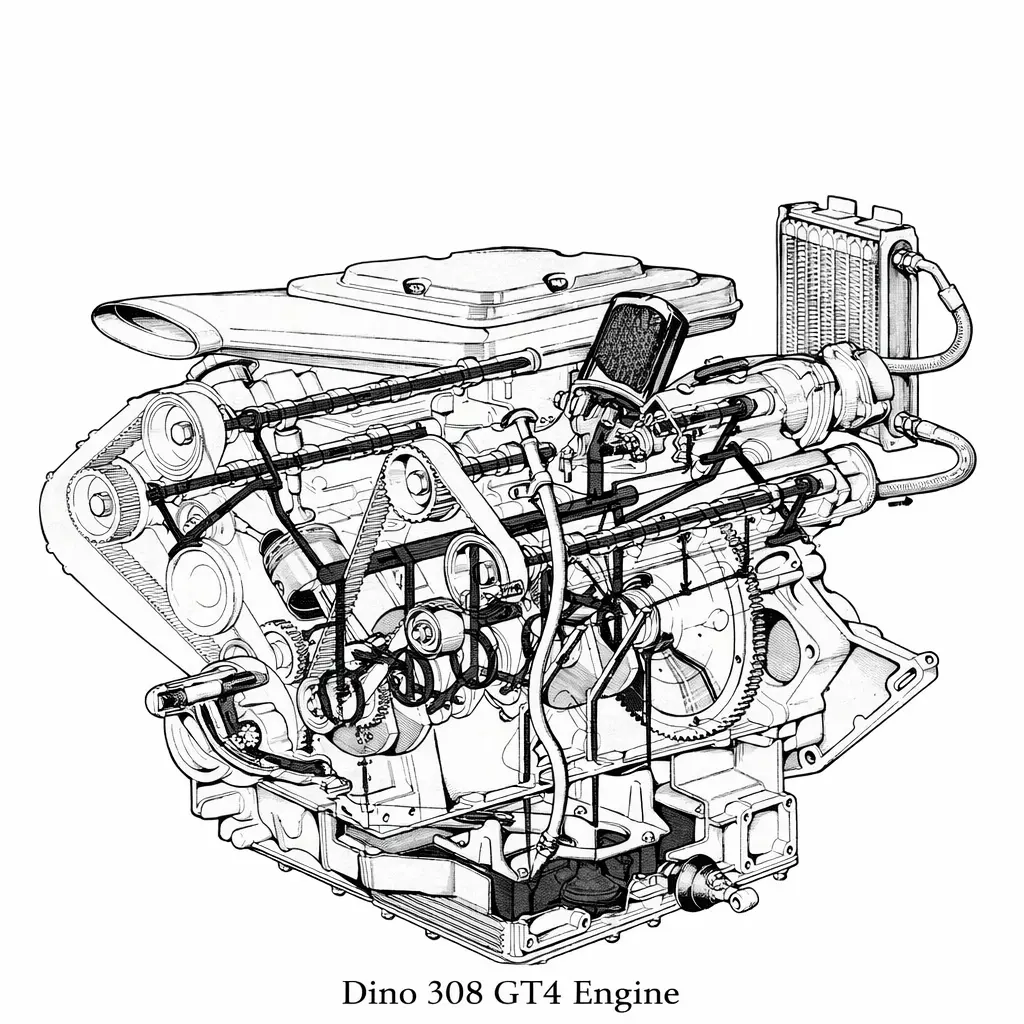
Developed under none other than Franco Rocchi, Ferrari’s first production V8 was conceived with racing principles in mind — but shaped for sustained road use. Compactness, efficiency, and balance in the F106A000‑coded engine mattered more here than outright spectacle.

At the heart of the design was a flat‑plane crankshaft. Unlike the cross‑plane layouts typical of many V8s, this configuration produced evenly spaced firing intervals — a mechanical clarity that sharpened throttle response, enabled precise exhaust tuning, and gave the engine its distinctive, urgent character.

Ferrari paired this architecture with belt‑driven camshafts, a relatively new solution for the company at the time, first explored on the 365 BB. The valvetrain used two valves per cylinder, fed by four twin‑choke Weber carburetors, while the aluminum alloy block followed classic Dino construction principles with wet, replaceable cylinder liners.

Even the engine’s dimensions carried familiar DNA.
Its bore and stroke — 81 × 71 mm — were closely related to Ferrari’s contemporary twelve‑cylinder 365 models, and several internal components were shared across engine families.
This was not compromise. It was strategy: proven parts, reimagined in a completely new layout.
Mobirise Website Builder

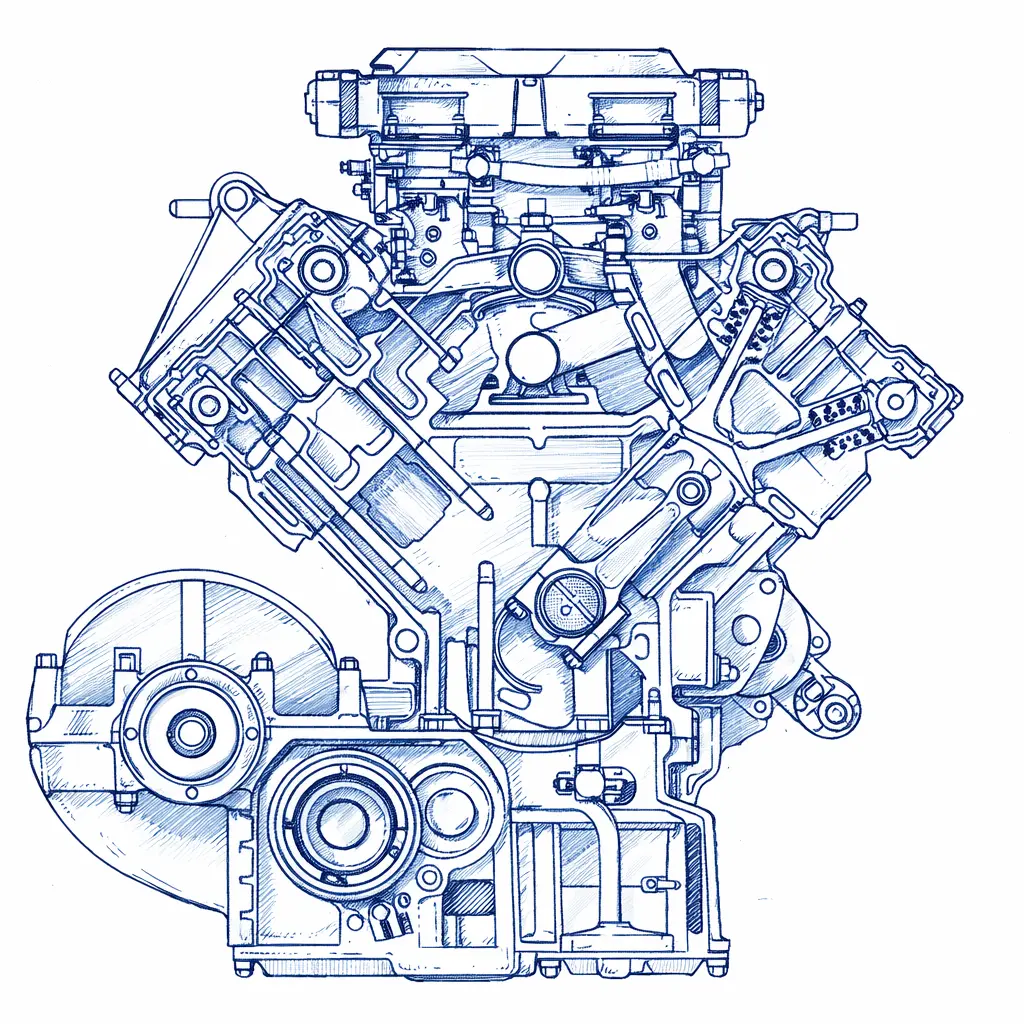
Cross Section view of the engine with the laterally offset gearbox, mounted under the engine.

A Road‑Focused Race Engine

The GT4’s V8 ran a compression ratio of just 8.8:1, a rather low-compression rate for it's large size. Yet, that figure was chosen deliberately. It allowed the engine to tolerate the variable fuel quality of the 1970s while still delivering crisp throttle response and strong mid‑range torque.
Combined with the short‑stroke layout, it created an engine that was eager to rev yet flexible in everyday use.

The lubrication and cooling systems were equally robust. The engine carried 8 liters of oil in its full circulation system — a generous volume that required sufficient warm-up phases but ensured stable temperatures during extended high‑rpm running.
The cooling system held a total of 18 liters of water, reflecting Ferrari’s intention that this compact V8 should withstand both spirited driving and long‑distance touring without thermal stress.

The Ignition evolved over time: early cars used twin distributors, while later engines (type F106A020) adopted a single eight‑plug Marelli system for improved reliability and serviceability.

Performance and Character

Although officially SAE‑rated at 255 horsepower with a astonishing 7,700‑rpm redline, the engine’s defining trait was its usability.
Power arrived smoothly and broadly, with strong mid‑range performance and little dependence on extreme revs — enough for 0–100 km/h in 6.8 seconds and a top speed of 250 km/h. Its specific output of roughly 80 hp per liter was highly competitive for a naturally aspirated road engine of the era.

More importantly, the engine felt alive. The flat‑plane crank gave it a sharp, almost metallic urgency, while the carburetors added a tactile, mechanical richness to every throttle input. It was a powerplant that rewarded precision without punishing imperfection — a rare balance in the 1970s.

And unlike the earlier Dino 206 and 246, the GT4 — and its V8 — were built entirely within Ferrari itself, signaling a subtle but meaningful shift: this was no longer an experiment on the margins, but the beginning of Ferrari’s next era. The transverse V8 layout introduced in the GT4 would go on to define Ferrari’s mid‑engined road cars for decades. 

Mobirise Website Builder

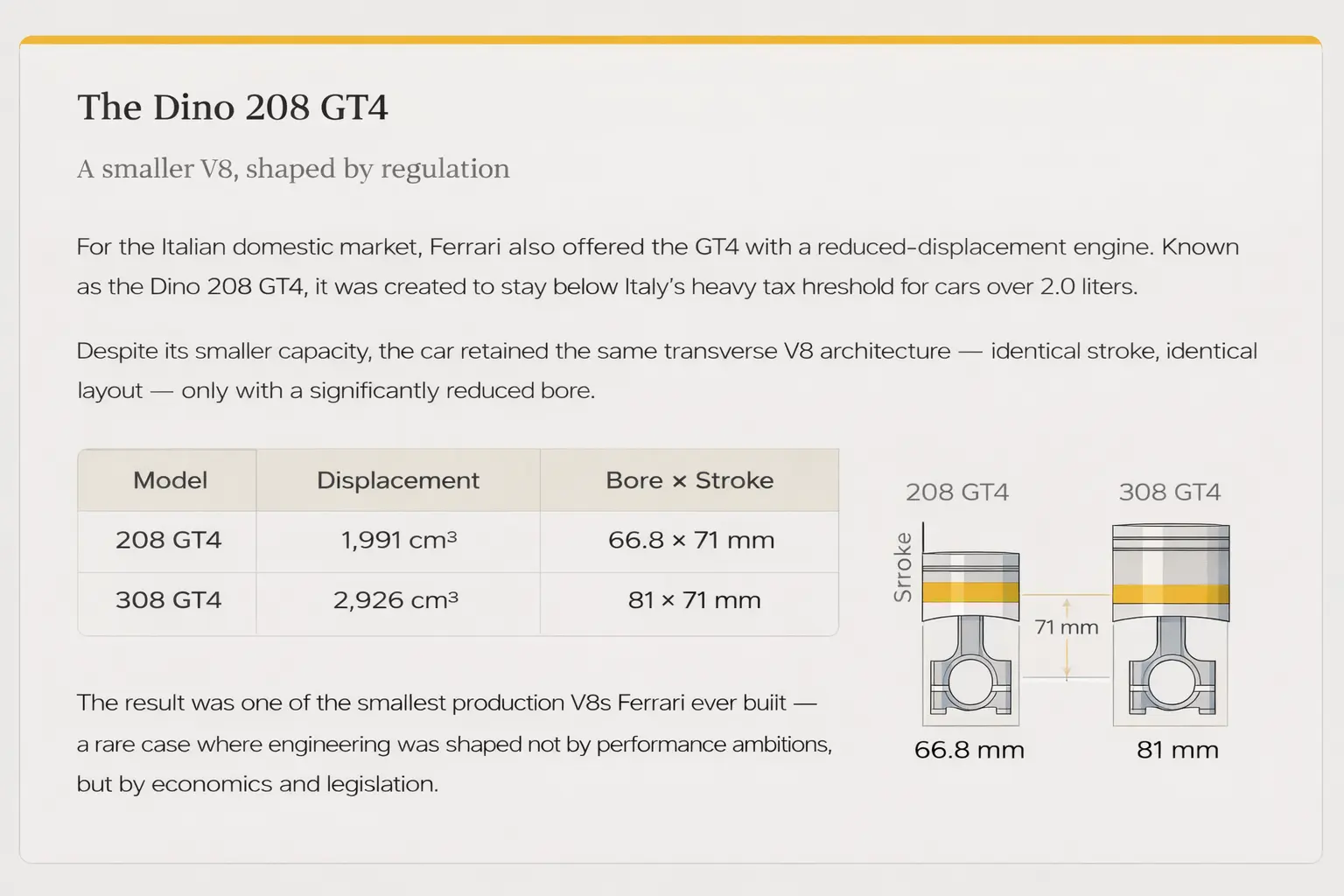
A smaller V8, shaped by Italian regulation - Dino 208 GT4

In an unusual twist, Ferrari also offered a version of the GT4 fitted with a 2.0‑liter V8 for the Italian domestic market, where engines over two liters were subject to heavy taxation.

Known as the Dino 208 GT4, this variant only ever came with Dino badging and shared the same V8 layout as the 308 but used a smaller bore (66.8 mm vs. 81 mm) and produced around 170 hp (125 kW) — making it one of the smallest production V8s ever. 
Despite the reduced output, it still managed 0–100 km/h in 7.7 seconds and reached a top speed of 220 km/h — respectable figures for such a downsized engine.

Seeing one on the road nowadays has become something of a lucky chance, as only 840 were ever produced.

"A bit less lyrical than the 246' V6 , but broader in torque and easier to live with."

Mobirise Website Builder

From the V6’s song to the V8’s punch: the moment Ferrari changed direction.

Where character changed, and a new era began.


Chassis and Weight Distribution

The chassis of the Dino 308 GT4 was engineered with a clear focus on rigidity and weight efficiency.

Its structure is based on a welded tubular spaceframe constructed from oval and rectangular steel sections derived from the 246 GT, and complemented by front and rear subframes. This configuration provides a high degree of torsional stiffness while allowing precise control over its suspension geometry.

To further reduce weight, the engineers employed a selective use of materials. The floor pan, front valance, inner wheel housings, and various body panels are made from glass‑fiber reinforced polyester, while the main body structure is formed from steel. The front and rear hoods are aluminum, as is the underfloor paneling.

Despite its practical 2+2 layout and relatively generous interior space, the GT4 remains notably light. With a full fuel tank, curb weight is approximately 1,320 kilograms — an impressive figure that contributes directly to the car’s agility, stability, and predictable handling.

Its proportions also play a key role: With an overall length of 4,300 mm, an unusually long 2,550‑mm wheelbase, and a height of just 1,210 mm, the GT4’s proportions were as purposeful as its engineering. The long wheelbase in particular set it apart from its successors and contributed significantly to its composed, confidence‑inspiring handling.

Additionally, by positioning the transversely mounted engine close to the center of the chassis, engineers achieved a balanced weight distribution that favors neutral behavior.

The reduced polar moment of inertia gives the GT4 real stability at speed and makes it both approachable and rewarding to drive. 

Mobirise Website Builder

Suspension and Driving Character

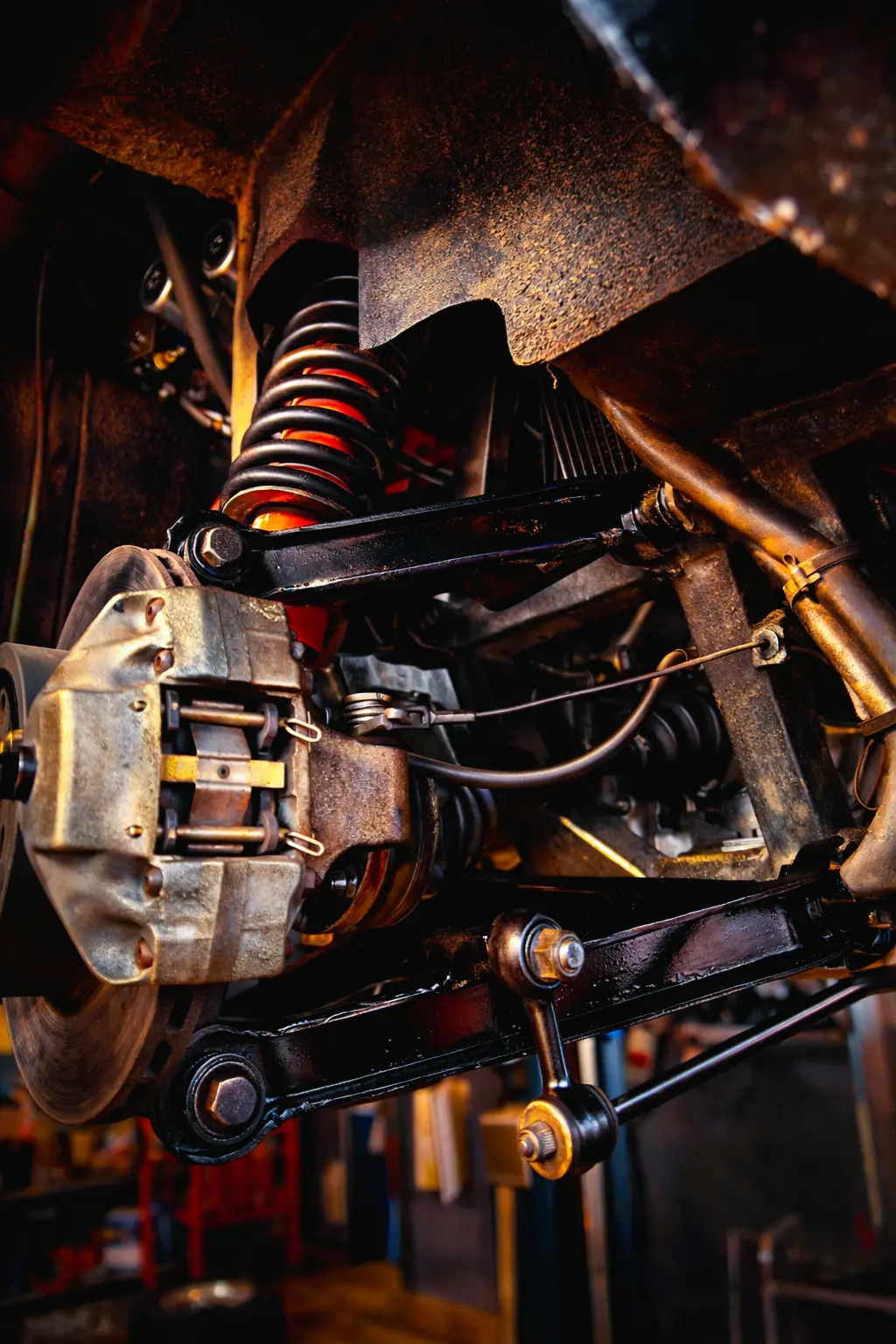
The suspension layout of the Dino 308 GT4 reflects Ferrari’s clear emphasis on balance, precision, and predictability.
Double wishbones are used at both the front and rear, combined with coil springs and Koni shock absorbers. Anti-roll bars at both ends further support stability and help control body movement without compromising ride quality.
Steering is handled by a rack‑and‑pinion system, offering direct feedback and a natural sense of connection to the road — a sensation amplified by the driver’s far‑forward seating position, which makes every input feel immediate and unfiltered.

Braking performance was equally well considered. The GT4 is equipped with four internally ventilated disc brakes and a dual‑circuit system, providing consistent stopping power and a reassuring pedal feel — qualities that contribute significantly to driver confidence, particularly during spirited driving.

Wheel and tire choices underline the car’s period‑correct but purposeful setup. The standard Cromodora magnesium alloy wheels measure 14 × 6.5 inches and are mounted via a five‑bolt pattern, typically fitted with 185 VR14 tires. As an option, Campagnolo “star” wheels were available in widths of 6.5 or 7.5 inches, allowing for a slightly more assertive stance and improved grip.

Combined with the GT4’s long 2,550‑mm wheelbase and its inherently balanced mid‑engine layout, these components give the car a remarkably composed and confidence‑inspiring character.
The GT4 turns in cleanly, remains settled even over mid‑corner bumps, and communicates its limits with clarity — traits that make it feel precise without being nervous, and rewarding without being demanding.

In the context of the 1970s, this was far from typical. Many contemporary sports cars — from the Porsche 911 to mid‑engined rivals like the Lamborghini Urraco or Maserati Merak — could be thrilling but also temperamental at the limit. The GT4, by contrast, offered a rare combination of agility and stability: sharp turn‑in without twitchiness, mid‑engine balance without unpredictability, and high‑speed composure enhanced by its unusually long wheelbase.

Taken together, the GT4 behaves like a car engineered to be driven with confidence, not apprehension — a machine whose stability and precision stem not from electronic aids, but from thoughtful mechanical design. 

The GT4 doesn’t feel dramatic — it feels precise.
And that precision becomes its own kind of excitement.

Interior Packaging and Ergonomics

The upright stance and large glass areas of the 308 GT4 were not stylistic indulgences.
They were functional solutions to real‑world requirements, shaping an interior that feels unusually open and usable for a mid‑engined sports car of the 1970s.

Inside, the GT4 combines this functional clarity with a distinctly Italian sense of occasion. Leather and velour are mixed in a way that feels both sporting and inviting, while the low, wraparound dashboard creates an intimate, driver‑focused environment. The instruments sit in three sculpted aluminum panels that arc gracefully behind the slender steering wheel — one of the most elegant dashboards Ferrari ever fitted to a road car.

The driving position itself is a defining part of the experience. You sit remarkably far forward in the chassis, with your feet extending almost above the front axle. Because the left wheel arch intrudes into the footwell, the pedals are slightly offset to the right — a typical 1970s Ferrari quirk that becomes second nature after a few kilometers.
This forward placement brings the driver physically closer to the car’s responses, making steering inputs feel immediate and enhancing the sense of precision and involvement.

The nearly panoramic windshield amplifies this effect. Its size and rake provide an expansive forward view that is rare among mid‑engined sports cars of the era, and combined with the forward seating position, the GT4 offers a level of situational awareness that feels almost modern.
Even backing up isn’t the blind exercise you’d imagine — the small rear window actually works surprisingly well. Especially when compared to other Sportscars of that era like the Lamborghini Miura or the later Countach, where outward visibility is dramatically more limited.

Haptically, the GT4 is unmistakably a Ferrari of its time. The open‑gate chrome shifter delivers the classic 1970s Ferrari gearbox feel: weighty, deliberate, and wonderfully mechanical. Each movement through the exposed shift pattern carries a sense of precision and theatre, reinforcing the car’s mechanical honesty.

Taken together, the interior of the Dino 308 GT4 offers a rare blend of visibility, ergonomics, and real engagement. It is a space that feels transparent, approachable, and deeply connected to the driving experience — a cockpit that invites the driver not just to operate the car, but to be part of it. 

The Blueprint for Ferrari’s V8 Era

The V8 engine type F106A000 (resp. F106A020) introduced in the Dino 308 GT4 would become one of the most influential mechanical foundations in Ferrari’s modern history.

What began simply as a pragmatic solution for packaging and usability to move with the market, evolved into a powertrain architecture that established Ferrari’s most commercially successful road cars.

In various displacements ranging from 2.0 to 3.2 Liters, this V8 went on to power models such as the 208 and 308 GT4, the 208 and 308 GTB/GTS, the 328 GTB/GTS, and the Mondial 8, QV, and 3.2.

It was in these later models — particularly the 308 and 328 series — that the "GT4 concept" of the Dino reached a much wider audience. More conventional styling, combined with the already proven mid-engine V8 layout, turned these cars into global icons. Popular culture played its part as well: appearances such as the Ferrari 308 GTS driven by Tom Selleck in Magnum, P.I. cemented the V8 Ferrari as a symbol of accessible performance and everyday usability.

Over a production span of approximately sixteen years, around 28,000 examples of this V8 engine family were built. With proper maintenance, these engines have proven to be robust, tractable, and well suited to regular use — characteristics that contributed significantly to their widespread acceptance.

Only much later, with the longitudinally mounted, 3.4 Liter engine of the 348 TB did Ferrari introduce a fundamentally new V8 architecture.

By that point, however, the principles established with the Dino 308 GT4 had already shaped an entire era of Ferrari road cars.

"The GT4, despite often being underestimated, shows that it belongs among great cars - because it proves to this day that packaging decisions can shape an entire era of performance."

When Design Followed Logic

The Dino 308 GT4 was never engineered to impress on paper, or to be a show-off.
It was engineered to make a new kind of Ferrari possible.

A mid-engine car with real space.
A V8 built for balance, not spectacle.
A layout that would quietly define decades of road cars to come.

In retrospect, the GT4’s greatest achievement is not one specific component.
But the clarity of the whole: engineering shaping its form, and its form eventually shaping Ferrari’s future.

To see the car from a more personal view:

Further Reading:

Image credits: Selected photography via Wikimedia Commons (Creative Commons licensed), and original images © mydino308.

No Code Website Builder